Indiana University
MAPS & DIRECTIONS Maps FIND PEOPLE Find People

Simulation

Fairbanks.jpg

  • 30,000 square-foot, high-fidelity simulation center jointly operated by Clarian Health and the Indiana University School of Medicine and School of Nursing
  • Fairbanks Hall, 340 W. 10th St. Indianapolis, IN - Fourth Floor
  • Advanced clinical training for IU nursing, IU medical and allied health students (the center encourages curriculum that is interdisciplinary)
  • Simulation and skills education for Clarian health care personnel, staff physicians and residents
  • To increase decision-making skills and enhance clinical reasoning
  • Ten-bed Objective Structured Clinical Exam (OSCE) Center: Simulated surgical suite, Emergency room, Transport room with ambulance, Five-bed virtual hospital unit, One obstetric room with newborn area, Intensive care unit suite, Two-bed vascular flex area, 1000 square-feet open classroom for skill set training, Twelve-seat computer lab
  • Mannequins / Simulations available: TraumaMan, Eye/Ear Sim, arterial puncture, pneumothorax, pediatric and adult intubation, tracheostomy, central line, lumbar puncture, knee aspiration
  • Additional classrooms and debriefing room

Sim Center.jpg

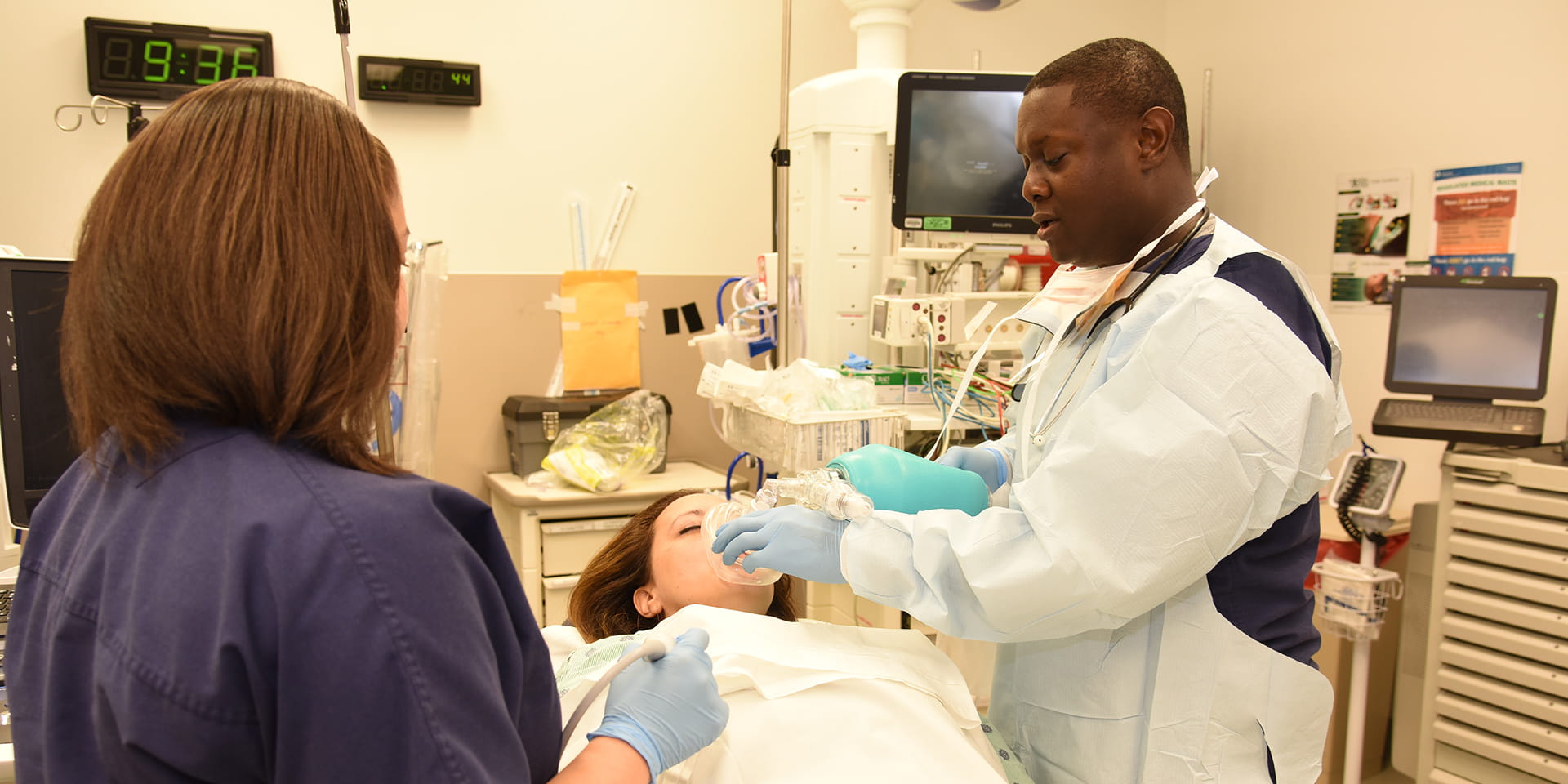
A description of the EM simulation experience:

  • Residents compete sessions in small groups of 5 or less
  • Currently, two trainers participate in each case:  1 in the control room with the tech and another in the room with the residents.
  • Multiple video cameras are located in each simulation room.
  • Centralized control center administered by simulation technicians with EM faculty and/or residents
  • Bluetooth capability for communication between control room and trainer in the room.
  • Each simulation room has its own debriefing room equipped with video replay
  • Phones in each room with call in/ call out capability to discuss case with simulated consultants.
  • Flat screen monitors in each room with capability to display images, laboratory values, etc.

Resident curriculum

  • simlab2.jpgIUEM is on a 13 block curriculum per academic year.

  • Each class performs simulation on even numbered blocks in the place of the didactic lecture series.

  • Pediatrics:  1/3rd of entire curriculum is focused upon pediatrics.

  • Each session is composed of three separate cases in which each debriefing period equals or exceeds the time devoted to the simulation session itself.

  • Residents alternate as the team leader for each case.

  • Block 1 includes an orientation session for new R1’s in which 3 cases are performed.simlab3.jpg

  • PGY-1 cases cover basic medical knowledge and resuscitation.

  • PGY-2 and PGY-3 cases incoporate advanced medical topics, rare medical cases, and systems-based issues.

  • Residents have an opportunity to serve as simulation trainers for the PGY classes 1 year or more below their academic rank (see Residents as Trainers section).

  • The bottom line:  Over the course of a 3 year or 39 block curriculum, IUEM residents will participate in 57 simulation case encounters.


Senior EM Medical Student curriculum

  • Emergency Medicine is a required rotation in the 4th year at Indiana University School of Medicine.

  • Medical students participate in simulation case scenarios during their EM rotation.

  • Formative debriefing is provided to students after each case.

  • EM residents also have an opportunity to serve as the simulation trainers for the medical student curriculum (see Residents as Trainers section).

  • Currently, over 300 senior medical students rotate through the IU EM clerkship.  This provides a tremendous educational opportunity and added visibility for the Department of Emergency Medicine.

Sim Session.jpg

To ensure a variety of learning opportunities, our upper level residents participate in teaching the simulation curriculum.  We believe this to be invaluable for our residents and learners alike. 

  • The residents monitor the case, direct changes, and take part in a formal debriefing as a member of the teaching staff.

  • IUEM residents have an opportunity to serve as simulation trainers for the resident and medical student simulation curriculum.

  • To participate as a trainer, residents must be at least one PGY higher than the residents or students participating in the session. Even PGY-1’s can serve as simulation trainers!

  • Conference credit when serving as a trainer:  Residents serving as trainers are eligible for conference credit during that block.


simlab4.jpg

Multiple simulation projects are ongoing. Examples listed below:

Publications:

  • Solway M, Wilbur L, Walthall J. Simulation Case: Neonate with Fever Requiring IO Line. MedEdPORTAL; 2011. Available from: www.mededportal.org/publication/8391
  • Collins M, Cooper D. Emergency Medicine Simulation Case: Septic Shock in the Geriatric Patient. MedEdPORTAL; 2011. Available from: www.mededportal.org/publication/8372
  • Cooper D, Humbert A, Huffman G, Perkins A. Residents as Teachers: EmergencyMedicine Residents are as Effective as Faculty in Medical Student Simulation Debriefing. Academic EmergencyMedicine Volume 18, Issue s1, Date: May 2011, Page: S78
  • Steinhofer J, Morrison R. Ventilator Management in Acute Asthma. MedEdPORTAL; 2011. Available from: www.mededportal.org/publication/8476
  • Rader K, Morrison R. Thyroid Storm Presenting as Gastroenteritis. MedEdPORTAL; 2011. Available from: www.mededportal.org/publication/8436
  • Snipes C, Walthall J. Peds Simulation Case: Kawasaki Disease. MedEdPORTAL; 2011. Available from: www.mededportal.org/publication/8423

Presentations:

  • Cooper D, Wilbur L.  Creating a sustainable interprofessional education simulation curriculum: Nursing Students,
    Medical Students and Emergency Medicine Residents.  2012 International Meeting for Simulation in Healthcare. San Diego, CA.
  • Cooper D, Wilbur L, Phillips J, Milgrom L, Ellender K, Huffman G.  Can Interprofessional Simulation Improve Physician – Nurse Communication and Error Reporting Confidence?  Abstract accepted to 2012 International Meeting for Simulation in Healthcare. San Diego, CA.
  • Hayden E, Cooper D et al.  Simulation in EM Clerkships:  A How-To Workshop, Society for Academic Emergency Medicine National Meeting, Boston MA, 6/2/11
  • Cooper D, Humbert A, Huffman G, Perkins A.  Residents as Teachers: Emergency Medicine Residents are as Effective as Faculty in Medical Student Simulation Debriefing.  Poster.  2011 SAEM Annual Meeting.  Boston, MA
  • Phillips J, Milgrom L, Cooper D, Wilbur L, Ellender K, Huffman G.  Blazing Change for Safer Care: Inter-professional Simulations to Improve Communication Between Nursing Students, Medical Students, and Emergency Medicine Residents.  Oral Presentation.  2011 Quality and Safety for Nurses National Forum.  Milwaukee, WI.
  • Cooper D, Humbert A, Huffman G, Perkins A.  Residents as Teachers: Emergency Medicine Residents are as Effective as Faculty in Medical Student Simulation Debriefing.  Poster.  2011 CORD Academic Assembly. San Diego, CA.
  • Cooper D.  Residents as Teachers:  Emergency Medicine Residents are as Effective as Faculty in Medical Student Simulation Debriefing, Society for Academic Emergency Medicine Midwest Regional Meeting, 11/6/10 (awarded Best Oral Presentation)

Current Scholarly Endeavors:

  • EM faculty and resident physicians as simulation trainers.
  • Validation of physician-nurse communication survey instrument.
  • Effects of simulation on physician-nurse communication.
  • Comparison of self vs peer vs faculty evaluations.
  • Collaboration with Pediatrics / Pediatric ICU / Neonatal ICU / Pediatric Surgery.

The simulation curriculum at IUEM is managed by an executive committee composed of faculty and resident representatives.  The Simulation Management and Oversight Committee meet regularly to assure continued success and expansion of the simulation curriculum.  The goals of this committee include: 

  1. quality assurance of the educational value of the curriculum;
  2. scholarly development of faculty and residents interested in simulation;
  3. inter/intra-departmental collaborative efforts
  4. pursuit of extramural funding to support the goals of the IUEM simulation program. 

Members of the Simulation Management and Oversight Committee:


Sim group.jpg